

10/349-351 MacDonnell Rd,
Clontarf, Qld 4019
Panel Glide Blinds for Queensland Windows and Doors
Angie Neal | November 2, 2026
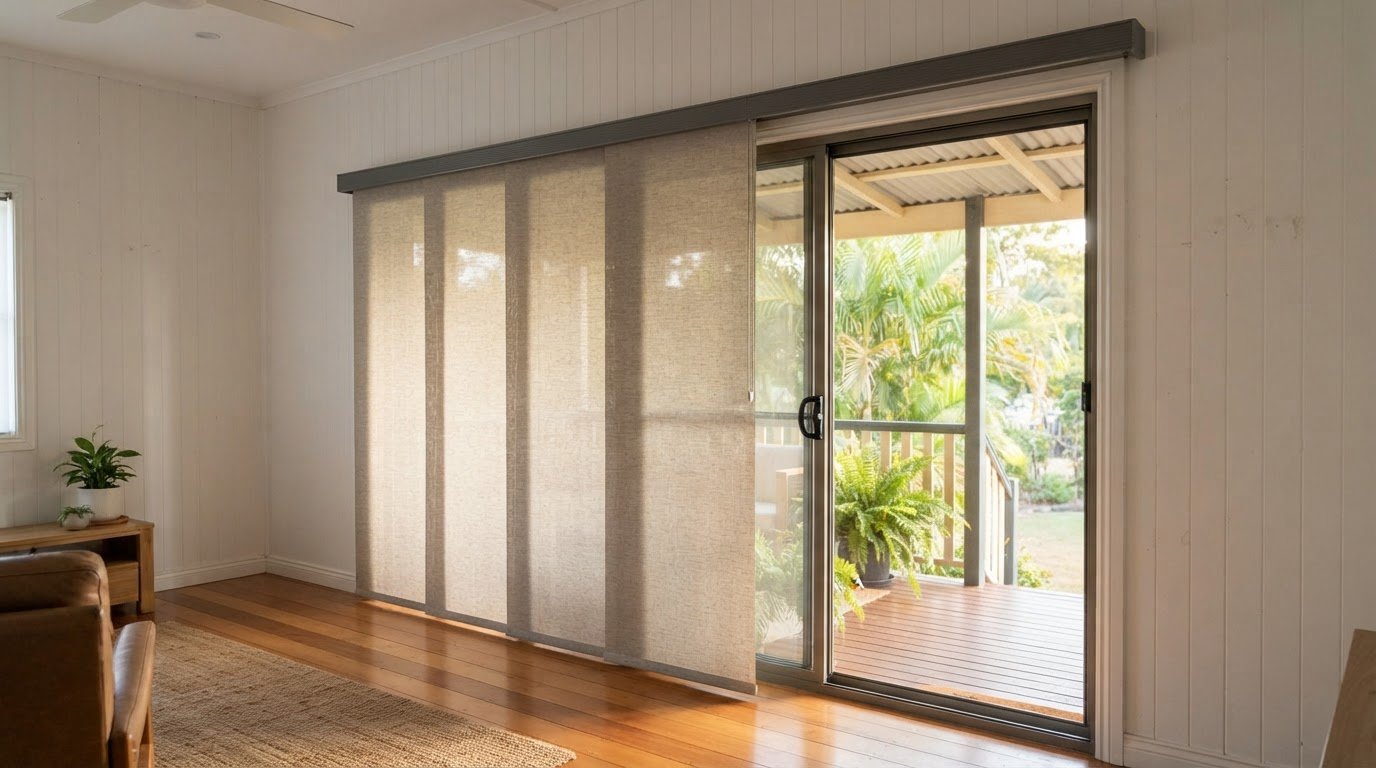
The way a blind opens matters as much as how it looks. Panel glide blinds use wide fabric panels that travel along a track and stack to one side when open, making them a practical option for wide windows and doors. They can also divide an open-plan room without adding a fixed partition.
For a Queensland home, consider the fabric, fit and room layout when choosing panel glide blinds. Think about how much light the fabric filters, where the panels stack and how the finish works with your space. Wand operation avoids cords, while gaps around the panel edges may let some light through.
This guide explains how panel glide blinds work and how they compare with vertical, roller and Roman blinds. It covers light-filtering and blockout fabrics, track colours and gentle vacuuming for routine cleaning. Use these practical points to decide whether the style suits your windows, doors and everyday routine.
Key Takeaways
- Choose a recess fit for a finish inside the window frame or a face fit to cover the frame, with measurements suited to the opening.
- Match fabric and track colour to the room, and consider how much light you want to filter.
- Compare how each blind style operates and stacks, and allow space for panels to sit when open.
- Keep the fabric looking tidy with gentle vacuuming using a brush attachment.
- QLD Shade’s Internal Blinds & Panel glides can help tailor an indoor window covering to your Queensland home.
What are Panel Blinds?
Panel glide blinds have wide fabric panels that travel across a track and gather to one side. Their broad sections suit windows, sliding doors and some open-plan layouts. Made to measure for a particular opening, the blind’s fit and panel layout determine how well it covers the frame and clears the space when open.
Made-to-Measure Options
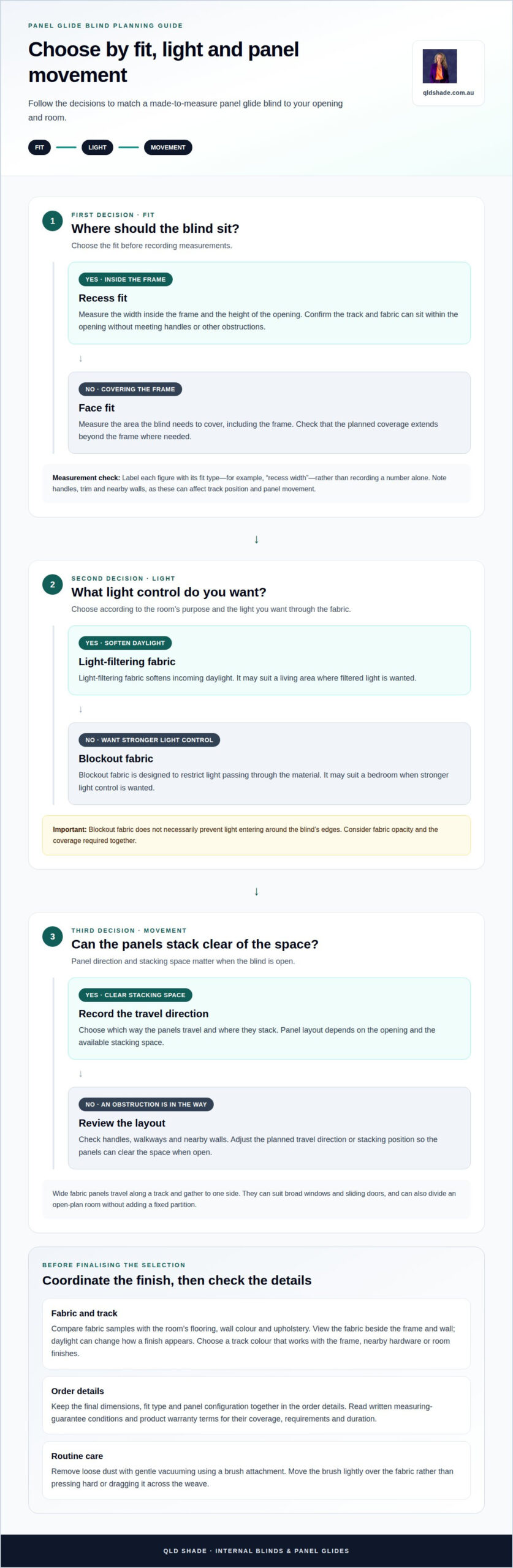
Made-to-measure options let the blind’s width, drop and fit suit the window or door. Choose a recess fit, which sits inside the frame, or a face fit, which covers the frame. Then decide which way the panels should travel and where they can stack without blocking a handle or walkway.
Before ordering, record the fit type alongside each measurement. For example, label a figure “recess width” rather than writing a number alone. This helps prevent applying a measurement to the wrong part of the opening. Plan the fabric coverage around how much of the frame or surrounding area you want covered.
Available Sizes and Panel Configurations
There is no single size or panel configuration for every Australian window. The finished dimensions suit the measured opening, while the panel arrangement depends on its width and the available stacking space. Panel glide blinds can be planned for a sliding door or broad window, with the opening direction guiding the layout.
For a recess fit, measure the width inside the frame and the height of the opening. For a face fit, measure the area the blind needs to cover, including the frame. Note handles, trim and nearby walls, as these can affect the track position and panel movement.
Read the written conditions for any measuring guarantee carefully. Check what measuring errors it covers, who must take the measurements and what remedy applies. A guarantee name alone doesn’t explain its limits. Warranty coverage also depends on the product terms, so read the written warranty for its coverage and duration.
Custom panel glide blinds are available through Australian window-covering retailers and installers that offer made-to-measure options. Ask for the final dimensions, fit type and panel configuration to be recorded together in the order details. This gives you a clear reference for the product and its intended installation.
For a face fit, check that the planned coverage extends beyond the frame where needed. For a recess fit, confirm the track and fabric can sit within the opening without meeting handles or other obstructions. These checks align the measurements, fit and panel movement before the blind is made.
Panel, track colour and fabric customisation
Customisation brings together the fabric’s appearance, light control and track finish. Fabric options include light-filtering and blockout styles, with colours and textures to suit the room and window treatment.
Panel and Track Colour Choices
Choose a track colour that works with the window frame, nearby hardware or other room finishes. A track that blends with a pale frame creates a quieter outline, while a contrasting finish makes it more visible. Consider the panels and track together rather than choosing either in isolation.
Before settling on a colour, view the fabric beside the frame and wall. Daylight can change how a finish appears, so compare samples in the room where the blind will sit. The track is both functional and part of the design: its colour can recede or provide a deliberate visual accent.
Fabric Colours, Textures and Prints
Fabric colours, textures and prints vary across ranges. A plain, lightly textured fabric can sit comfortably beside patterned furnishings, while a print can become a feature against simpler walls. When judging a pattern, look at it across the full panel area, not just on a small swatch.
Compare a sample with the room’s flooring, wall colour and upholstery. A warm neutral, for example, may complement timber finishes, while a cooler tone can work with a grey interior. Check the fabric in daylight and evening light before choosing.
Light-Filtering and Blockout Fabrics
Light-filtering fabric softens incoming daylight, while blockout fabric is designed to restrict light passing through the material. Consider this difference when choosing an opacity level. A living area may suit filtered light; a bedroom may call for stronger light control.
Blockout fabric does not necessarily prevent light entering around the blind’s edges. Consider both the fabric and the coverage required, especially if you want a darker finish. The right choice depends on how you use the room and the light control you want from the panels.
Fabric Types and Light Control
Opacity is only one part of fabric selection. Texture, colour and print affect the finished look, while the fabric determines whether the panels filter light or provide blockout coverage. Compare these qualities with the room’s purpose instead of choosing on colour alone.
For fabric labelled Lynx Blockout, consult its product specifications for composition, care guidance and light-control details. The name alone does not provide this information. Review the specification alongside a sample, then consider how the fabric will look across the panels’ full width.
A practical selection sequence is to decide the room’s light-control needs, compare fabric samples with existing finishes, then coordinate the track colour. This keeps appearance and function aligned. Explore custom internal blinds and panel glides as part of planning a made-to-measure window treatment.
Cleaning and maintenance
For fabric panels, gentle vacuuming with a brush attachment is a simple way to remove loose dust. Move the brush lightly over the fabric rather than pressing hard or dragging it across the weave. Work from top to bottom, supporting the panel so it does not pull against its fittings.
Before cleaning, close the blind and make sure each panel hangs freely. Start at the top edge and vacuum down each panel in steady passes. Pay attention to folds, seams and lower edges, where dust can collect. If panels overlap, move them carefully to reach the fabric beneath. Avoid catching the brush on stitched edges or weights.
For marks or spills, check the fabric’s care instructions before applying water or a cleaning product. Finishes can respond differently, and an unsuitable cleaner may change the colour or texture. Don’t scrub a spot, as rubbing can spread the mark or disturb the fabric. Follow the care guidance for that fabric and test any permitted method in an inconspicuous area first.
- Fabric panels: Use a brush attachment and gentle passes to remove loose dust.
- Stains: Read the fabric care instructions before treating a mark.
- Track: Look for visible dust or an obstruction if panels stop moving smoothly.
- Operation: Move panels evenly and avoid pulling sharply on fabric or fittings.
Include the track in routine care. If a panel catches or stops moving smoothly, pause rather than forcing it. Check the visible track for loose dust or an obstruction, and remove anything accessible without dismantling the fittings. If movement remains stiff, follow the product’s care instructions. Avoid applying oil or lubricant unless those instructions specify it.
Windows near kitchens or frequently opened doors may expose fabric to more airborne dust or cooking residue. Inspect panels as part of ordinary household cleaning and vacuum when visible dust appears. Avoid harsh brushes or aggressive movements. The aim is to remove surface dust while preserving the fabric’s finish.
Handle the panels gently when opening or closing them after cleaning. Keep your hands clean, guide the fabric rather than tugging its edges, and check that each panel moves without catching. A light-touch routine helps keep the fabric and track presentable without unnecessary cleaning products or complicated maintenance.
Comparison with vertical, roller and roman blinds
Panel glide blinds suit broad windows and doors where fabric panels can travel along a track. Their contemporary, linear look works well across a wide opening, but the panels need space to stack when open. Because the edges may not seal tightly, light can leak around the sides. Consider this trade-off in bedrooms or media rooms where limiting stray light matters.
Vertical blinds use hanging slats that turn to adjust light and privacy, letting you change the angle of incoming daylight without drawing the whole covering aside. Panel glide blinds instead move wider sections across the track. Consider whether you’d rather adjust separate slats or move larger panels, and how often you expect to change the light during the day.
A roller blind uses one sheet of fabric that rolls up above the window. It clears the view when raised and does not create a side stack, which can help when wall space beside the opening is limited. A single roller may be less suited to a very wide opening as one continuous piece. Compare the opening’s width, desired coverage and available mounting space before choosing.
Roman blinds fold into soft horizontal sections as they rise, creating a gathered fabric finish. Panel glide blinds keep broad sections hanging vertically for a flatter, more architectural appearance across a door or wide window. The choice affects the room’s visual balance: a simple panel finish can complement clean-lined interiors, while folded fabric can add softness beside upholstered furniture.
Panel glide blinds offer broad fabric coverage, a contemporary appearance and panels that move aside along a track. The trade-offs are the space needed for stacking and possible light leakage around the edges. Decide based on the opening, the room’s light-control needs and whether the open stack could affect nearby furniture or a walkway.
- Choose panels when broad fabric sections and a side stack suit the opening.
- Choose vertical slats when adjustable slat angles matter for managing daylight.
- Choose a roller when a single sheet that rolls clear is the priority.
- Choose Roman folds when a gathered fabric appearance suits the room.
Picture each option fully open as well as closed. Check whether a panel stack would cover a doorway, overlap furniture or obstruct a handle. Consider where light might enter around the edges, too. A style that looks right when closed should also suit the room’s movement and everyday use.
Because panel glide blinds may not seal tightly, light can leak around their edges. Keep this in mind when deciding whether they suit spaces where light control matters.
Panel glide blind design and operation
Yes, panel glide blinds can suit sliding doors and wide windows because broad fabric panels travel along a track. Installation involves securing the track, attaching the panels and checking their movement; confident DIY fitting requires accurate positioning and secure fixing.
The track guides each panel across the opening. When you draw the blind open, the panels gather into a stack at one side; when closed, they spread across the window or door. Wand control moves the panels without cords, providing a direct way to open and close the covering.
Plan the stack position before choosing the operating direction. Stand at the opening and identify which side has clear wall or window space. If a handle or doorway sits beside the left edge, for example, stacking the panels on the right may keep that area accessible. The layout should work with how people enter, leave and use the room.
Allow room for the gathered panels when the blind is open. A narrow wall section beside a window may not leave enough space for the full stack, while an unobstructed area beside a sliding door can make access easier. Consider nearby furniture, light switches and door handles, too. These details affect how freely the panels move and where they rest.
During installation, position the track as planned and keep it aligned with the opening. Attach the panels so they can travel along it. A DIY installer needs to measure the mounting position carefully, use fixings suited to the mounting surface and follow the product’s installation instructions. Poor alignment can affect smooth movement.
After fitting, test the blind through its full travel. Use the wand to open the panels, then close them again. Watch for catching, uneven movement or panels that do not stack as planned. Check that the stack does not obstruct a handle or the main route through the doorway. It is easier to address an issue at this stage than work around it every day.
Operation is straightforward, but the track and stack determine how practical the design feels. Before choosing a layout, match the opening direction to the room’s traffic and confirm there’s space for the panels when open. For a tailored track and panel arrangement, book an in-home measure and quote.
Panel glide blinds use wand control rather than cords, avoiding cord-related entanglement risks. They also need space for the panels to stack when open, which may not suit narrow or confined areas. Check the available space when planning the layout.
QLD Shade: Internal Blinds & Panel glides
QLD Shade supplies and installs Internal Blinds & Panel glides for homes across greater Brisbane. A free in-home measure and quote helps match the track position, panel arrangement and fabric choice to your window or door.
Turn to QLD Shade when you’re ready to move from comparing blind styles to planning a fitted solution. An in-home measure considers the opening and available stack space, while your fabric and light-control preferences guide the selection. This is particularly useful for wide windows and sliding doors where fit and access affect everyday use.
If you’re considering panel glides for your home, contact QLD Shade to discuss your windows and arrange a free in-home measure and quote.
Choose the right fit for your next step
Think about how you want the room to feel and function, not just how the window covering looks. A wide glazed opening, a busy doorway and a bedroom each place different demands on a blind. With those priorities clear, it is easier to decide whether panel glide blinds suit the space or another style is a better match.
For other needs around the home, QLD Shade also offers Zipscreen, Heavy duty commercial channel blinds and Indoor PVC Shutters. The right option depends on the opening and how you use it, so focus on the practical result you want in each area.
Ready to discuss a tailored solution for your windows or doors? Contact QLD Shade about panel glide blinds, and take the next step towards a more comfortable, considered space.
Frequently Asked Questions
What are panel glide blinds and how do they work?
Panel glide blinds use wide fabric panels that slide along a track, making them suitable for broad openings and room dividers. A wand moves the panels across the track, without cords. For example, in an open-plan home, they can separate a living area from a dining space while still allowing the panels to be drawn aside. Plan the opening and stacking direction around how you use the room.
How do panel glide blinds compare with vertical blinds, roller blinds and curtains?
Each style suits a different look and routine. Vertical blinds use adjustable slats, roller blinds lift a single sheet of fabric, and curtains hang from a rod or track for a softer, fuller appearance. Panel blinds create a flatter, more structured finish across broad openings. Consider the space beside the window, the room’s style and how you want the covering to look when open.
How do you measure for panel glide blinds?
First decide whether the blind will sit within the frame or cover it, as each fit uses a different measurement area. For a face fit, include the frame and the area you want covered; for a recess fit, measure inside the opening. Note nearby trim, handles and the direction the panels should move. Label every measurement clearly as width or drop to avoid mixing them up.
How do you clean and maintain panel glide blinds?
Gently vacuum the fabric with a brush attachment, following its care guidance for marks or spills. Avoid vigorous rubbing or cleaning products unless the fabric’s instructions permit them. As part of routine care, move the panels through their full travel and look for visible dust or anything obstructing the track. If movement changes, do not force the panels; follow the product’s maintenance instructions.
Ready to Transform Your Space?
Take the next step and discover the right blinds, shutters, awnings for your space.
Get a Free In-Home Measure & Quote
Contact QLD Shade today for a free measure and quote and discover why Brisbane homeowners trust us for premium outdoor blinds and awnings.
GET IN TOUCH
FOLLOW US: